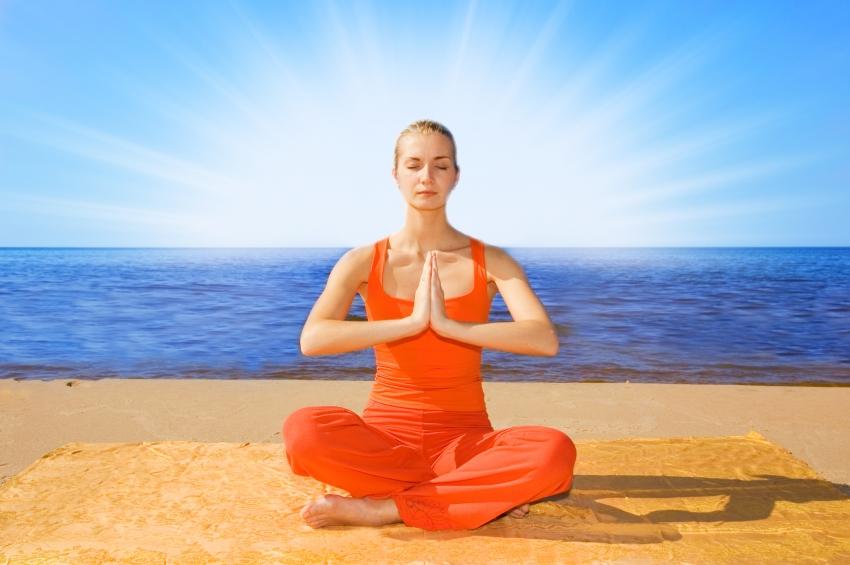
Meditation is a form of spiritual practice. Many religions and denominations know the meditation in one form or another.
In the 20th century in the West renewed interest in meditation and consciousness expansion. Meditation is now known from from Hinduism and Buddhism, in which meditation is an essential method to their own spirit.

Meditation refers to a wide spectrum of spiritual exercises. The word comes from the Latin word meditatio, which in turn is derived from the verb "meditari" that reflect, ponder means. It is also related to joint ac, cure (compare drug) [source?]. A distinction can be made between contemplation, concentration and meditation vipassanameditatie. Within these three forms exist many variants.

In Christianity, meditation is often referred to contemplation. Contemplation is the consideration of a text from the Bible or an event in the life of Jesus, making this text or event meaning and is internalized. Examples are the temptations of Jesus in the desert, or the suffering of Christ. Often this form of meditation associated with a form of devotion.

Meditation means in the Western tradition also pondering on something, like Descartes meditations are also called: think about something deeper, fundamental questions about or problems.
Concentration meditation has focussed on an object, image or sound, for example (a) god, a candle flame, breathing, or elements from nature.

This form of meditation has an object-oriented phase and a phase object free
Object-oriented meditation involves focusing the attention on one point. After some practice it is discovered that the focus not so quickly distracted by external impulses. This is called the one-pointed to make the said attention. Forms of such object-oriented forms of meditation include transcendental meditation and centering prayer.
After the one-pointed attention to the intention is that the attention that completely relaxes and free meditation object is created. This is also the return of attention to 'the source' mentioned. At that time expires, the distinction between 'object' and 'the whole': everything melts together into One.
Free meditation object is not directed at an object or figure, nor an object in the form of a thought or feeling. Freedom of objects - the meditative state - arises naturally when the attention or focus completely relaxes.

In Vipassana meditation, nowadays better known as mindfulness, attention is not focused on a point, but the mind is actually trained to be aware of all the changes taking place in the body and consciousness. This one is aware of the changing nature of reality.

In Vipassana one is aware of all the emerging thoughts and emotions, but leaves them no longer pass them by. It attaches no importance to and looks to distant, as if they belong to someone else, or as a cloud in a bright sky float by. Jiddu Krishnamurti calls this meditative attitude "choiceless awareness" (choice-less awareness).

Meditation exercises come in many religions [1]. In the West, the Christian, Hindu and Buddhist versions the best known. The concept of meditation has several meanings in these traditions, which are partly overlapping and partly different.

In Christianity, the words contemplation, meditation, centering prayer and Lectio Divina usual. Contemplation means contemplation, consideration. Lectio Divina is a contemplative method. This is a Bible or other text silently considered the various meanings to themselves to penetrate. This gives the text meaning and depth [2]. In meditation, the attention is focused on a specific object such as a picture or sound. In centering prayer, one or two meaningful words from a text appealing in mind repeated, allowing the mind to rest [3] [4].

Hindu meditation is particularly known for the Yogasoetra of Patanjali, in which the method of stilling the mind described. This is a form of concentration meditation or samatha. It concisely describes this approach in the 2-4th sutras of Chapter 1 'Samapadhi':
Now a discussion about yoga, yoga movements in the mind to rest, then the seer rests in his true nature, lest the seer identifies itself with the movements.

After complete relaxation of attention creates a state witness. This witness is not an object itself. One can witness this not so know, using the senses. This witness, according to Swami Sivananda of Rishikesh, India, the true 'I', called the Atman. Christians would call it the Soul. The Dutch word "breath" and the German verb atmen probably have the same origin as the Sanskrit atman. In the Bible God blows his breath life into a man of clay. He "inspires" therefore man. This spirit is the divine spark of consciousness through meditation can return to God (Brahman). The Atman is that which thinks through the mind, sees through the eyes, eat by mouth, hears through the ears, smells through the nose and feel through the body, but remains untouched in via these senses. This true 'I', the only witness consciousness that is present in all people. By continuing meditation and finding silence according to the Upanishads man discovers that he has an immortal Soul or Atman, and Atman merges with Brahman "TAT svam asi" - "THAT (Atman) is what you are" [5].

Ramana Maharshi saw self-examination as a form of meditation. He gave out the following method: whenever a thought, emotion or urge arises, introduce oneself the question "who has this thought, emotion or desire". The answer is obviously "I". The second question we must then ask is "who is this I?". With all these questions are emerging associations of ideas and emotion flows constantly interrupted. The attention is thus shifted to a consideration of the source of all of this activity. This results in true self-knowledge, because they pass all the answers rest in the spiritual heart, where silence reigns.

Buddhism has also concentration-meditation. In addition, the vipassanameditatie Buddhism which is practiced in carefully observing the changes of mind.
In the Maha Satipatthana Sutta Gautama the Buddha explains how both meditation techniques work and how they compare to each other.

The distinction between concentration and mindfulness meditaie is not strict. Ven. Bhante Vimalaramsi assumes a combination of tranquility and insight meditation. He bases this on the sutta's. Within Vajrayana Buddhism (including Tibetan Buddhism), there are techniques that combine these two main forms. And Zen can also be seen as a combination of both, although the emphasis is on concentration is stronger.
In Tibetan Buddhism, meditation is the word for "gum" which translates as 'habituation'. This means it is accustomed to positive states of mind and avoidance of negative states of mind.
Meditation can be compared with growth of the lotus from the mud to the light. The lotus is a flower under water, in the dark, in the mud, root and grows toward the surface. If they are above the water comes out, unfolds in the light of the sun. The mud is symbolic of the difficulties that we encounter on earth, the dark water is the painful emotions that are triggered thereby. The unfolding of the lotus above the water, under the influence of the sun, stands for the liberation of all care and to find happiness, love and light.
Jesus is said that he could walk on water. This could also be seen as overcoming emotions and difficulties, after reaching deep insight.
In Hinduism we find this theme again: the Hindu gods are all depicted with lotus feet or sitting on a lotus unfolded as a sign of liberation from earthly care.

Meditation is to find the middle between two opposites, allowing insight into the complementarity of opposites occurs and the intransigence of the duality in the synthesis disappears. Meditation helps especially when eventually realize that the duality is a subjective illusion. This is illustrated by yin and yang, day and night, man and woman, the contradictions can not exist without each other and blend together. Each contains a portion of the other. The sunlight creates shadow and at night the sun creates the reflection of moonlight. Every man has a feminine aspect and every woman a masculine aspect. So everything is running into each other.
Meditation can be a method by which man ennobles and elevates himself. It reminds me of the quest of the medieval alchemists for the philosopher's stone, need to be able to change lead into gold. The dull lead is a symbol for the state of an introverted, selfish, facing away from the light, darkened mind. The shiny gold stands for the man with a liberated, independent and enlightened mind [source?].
The Sufis know this concept well. Also with them is the search for the transformation of a base metal into precious metal model of a spiritual process. Instead of lead they use mercury. Mercury is a liquid metal, which is always in motion, just as man's thoughts and emotions. In the Sufi alchemy of mercury first silver and then gold. The mind and the emotions are stilled. The essential ingredient for this change, the catalyst is fire or heat, which the Sufis is a symbol for love, love for others, love of God. In them we see that the reorientation of itself to others as is necessary to refine and virtuous man to live. Love to the people and the love of God is what the Sufis to the alchemists the philosopher's stone is. According to the Sufis only makes the love life worthwhile. That's why they call their method of meditation "the alchemy of happiness" [source?].
Meditation as a method of alchemical transformation to liberate the human spirit, can also be seen as a pursuit of happiness. Falun Gong is no distinction between the spiritual heart and the mind [source?]. The Sufis agree with that, because according to them, detects only a liberated spirit which is love, a love which then radiates from the purified heart.
From the standpoint of neuroscience, meditation can be considered as a series of exercises which a person control over his own brain processes [6]. Research on the brain activity (EEC) of experienced practitioners of meditation show that meditation during regular synchronous high-frequency waves in the EEG, called gamma waves occur [7] [8]. Gamma waves appear to be generated by inter-specific neurons in the cerebral cortex that fires quickly and have short connections with other neurons [9].
There are four brain structures involved in meditation:
Superior frontal sulcus and the sulcus intra-parietalis: the focus of attention
Dorsolateral prefrontal cortex: register or attention disappears
Ventrolateral prefrontal cortex: Helps thoughts behind each stimulus is concerned, and inhibits the anxiety and pain centers
Visual cortex: linking attention with such a picture
There are therapists who integrate Western psychotherapy and Eastern spirituality pursuit: the Diamond Approach of AH Almaas [10] [11] [12] [13], quantum consciousness approach of Stephen Wolinsky [14] [15], in his orientation of Hans Knibbe [16] [17], and several therapists who have no specific name to their approach [18] [19].
Meditation exercises are also increasingly used as an adjunct to psychotherapy. Especially in the form of mindfulness based cognitive therapy (MBCT), translated into Dutch with Mindfulness-Based Cognitive Therapy. The effect of an eight-week training and relapse prevention for people with recurrent depression is good. After attending the training shows a posttest after 60 weeks that the course participants had less depression (approx. 45%) than the control group. Also with other psychological symptoms MBCT works although there is still much research to be carried to its usefulness scientific foundation [source?].
For psychologically vulnerable people would be "too deep" meditation can be risky. When this meditation method in mental health is used in patients suffering from anxiety disorders, depression, stress or chronic pain, it would be counterproductive sometimes can develop when repressed emotions emerge. Then it would consult a specialist in psychological damage traumatologist a better alternative. Coping with trauma and difficult to unravel emotional knots would be healing in itself,
"But if not properly done, it is not without danger. In the worst case, the person much sicker and even endanger life." [20]
Hans Wolfgang Schumann warns that the meditation techniques of concentration and choiceless awareness is not without danger: too much has a "psychological drowning" due to careless use and can lead to mental slippage:
"In the psychiatric hospitals of Rangoon and Bangkok is a considerable number of patients who have had to pay for meditation wrong with their mental health" [21].